Forward-looking
For investors and partners
In a single year, foreign funding of Ukraine's defence industry grew 10× — from roughly $600M in 2024 to $6.1B in 2025. UVS Dynamics sits at the rare intersection of two strong trends: Ukraine's defence autonomy and the global shift into upper mid-band spectrum.
Foreign Funding of Ukraine's Defence Industry (2024–2026)
| Year | Funding, billions USD | Data type |
|---|---|---|
| 2024 | $0.60B | Sourced figure |
| 2025 | $6.10B | Sourced figure |
| 2026 | $8.50B | Projected (May 2026) |
A structural shift
This is not a cyclical bump — it's a new normal
The channels through which allied budgets fund Ukrainian defence manufacturers directly are new: the Danish model was established in 2024. In 2024 that funding reached $0.6B. In 2025 — $6.1B, a tenfold step in a single year. That is an inflection point, and three structural drivers stand behind it.
01
Allied direct-procurement models
The "Danish model" channels foreign funding directly into Ukrainian manufacturers. In 2025 that funding totalled $6.1B: nearly $1.8B under the Danish model and over $4.3B through direct procurement by partner states. A further $5B of Ukrainian defence-industrial projects has been submitted under EU SAFE and is awaiting a decision. The "Dutch model" adds a dedicated startup focus. Ukrainian producers become investable not only through VC, but through allied defense budgets.
02
NATO and EU integration
The joint NATO–Ukraine UNITE programme (€10M pilot, with a planned scale-up to €50M in 2026) recognises Ukrainian defense-tech as a source of innovation for the whole alliance. Brave1 — the central cluster — now lists over a thousand registered companies and has issued 750+ grants worth UAH 3.7B, with foreign-investor access.
03
Private capital catching up
Venture investment into Ukrainian defense-tech startups: $5M (2023) → >$40M (2024) → $105M (2025). Rapid year-over-year growth. The Brave1 US Roadshow in 2026 drew interest from 100+ American investors with combined AUM over $15 trillion.
Where we sit in this picture
Why UVS Dynamics is not just "another Ukrainian defense startup"
01
Hard tech, not software
In-house RF stack, FPGA logic, antenna arrays, custom boards. High barriers to entry and IP that's hard to replicate — unlike yet another DJI overlay.
02
Spectrum with civilian ROI
X-band — the band we operate in — overlaps the 7.125–8.4 GHz range that WRC-23 put on the WRC-27 agenda as candidate 6G upper mid-band (FR3) spectrum. Same physics, same component set, same design skills — so the expertise and hardware retain value after the war: telecom equipment, satellite ground stations, industrial sensing.
03
Ukrainian production
We qualify for Danish/Dutch model financing. A foreign partner can fund our production directly from their defense budget, without going through the Ukrainian state.
04
One product in hardware
One radio product in hardware: UVS Link — an X-band converter pair with a 2 W amplifier. Boards are built and running; in August 2026 the pair passed its first end-to-end video, wired and over the air on the bench, and the full transmit chain — source, converter, amplifier — was measured end to end. Ahead: flight trials, then a rev-2 board revision and readiness to order a small series. The same converter platform is being specified as a front-end variant for drone-detector manufacturers (requirements stage). We publish no dates that depend on trial results or third parties.
Roadmap 2026–202705
Stage ready for seed / pre-A
Boards built and running: the converter pair and the 2 W amplifier are measured on the bench, and in August 2026 the pair passed its first end-to-end video, including over the air on the bench. Release images are built by CI from tagged sources. Ukraine's Innovation Development Fund, which runs Brave1, concluded the project may be considered promising for the needs of the Armed Forces. Next: flight trials, then the rev-2 board revision. We are raising a seed / pre-A round. Invested to date (as of June 2026): a UAH 4M Brave1 grant and roughly $95K of the founders' own capital. Revenue starts with the first small series, for which we publish no date. Round size, terms, use of funds and unit economics are in the deck, shared under NDA. For technical specifications and programme status, this page is the current statement — we publish figures as they are measured.
Second line
A separate product — UVS Vision: onboard computer vision for UAVs
In parallel with the radio line, the team is developing a computer-vision product line: GPS-denied visual navigation and automatic target detection. This line has its own roadmap and its own go-to-market path; it sits outside the radio Roadmap.
See UVS VisionThird line
A separate product — UVS Detector: SDR-based radio-monitoring platform
A hardware/software stack on top of SDR for the tactical operator: sweep · detect · classify · identify · decode in a single operator-grade UI. Sales channel — direct engagement with tactical units under NDA, with a hardware-key licensing model in development; market and sales rhythm differ from the radio products. Its own roadmap; sits outside the radio Roadmap.
See UVS DetectorIntegration into third-party platforms
We build our own UAV testbed — so we know how to integrate into other manufacturers' platforms
Building and ground-testing our own HAL-9001 UAV is not our primary business, but it gives us first-hand understanding of interfaces, packaging, and aerodynamic constraints. That understanding transfers directly to other manufacturers' platforms: we see what to integrate and how, without leaning on someone else's datasheet — which is what shortens an OEM's spec-to-flight cycle.
See HAL-9001Competitive landscape
How UVS Link stacks up against existing UAV datalinks
Established Western and Ukrainian solutions sit in L/S/C and sub-6 GHz — exactly the bands saturated by EW. Domestic production of X-band UAV data links in Ukraine is virtually nonexistent; that is the gap UVS Link is built to close.
| UVS Link | TeleTactica V/C | Silvus Technologies | Doodle Labs | |
|---|---|---|---|---|
| Frequency band | X-band | S-band | L / S / C | sub-6 GHz |
| Spectrum saturation | Low | High | High | High |
Band classification from publicly available vendor documentation, current as of 2026. We do not score other vendors on capability, and we do not publish range or throughput figures for UVS Link until they are measured in flight. Pricing intentionally omitted.
Civilian ROI
Same platform — in peacetime
The X-band hardware we build doesn't disappear after the war. One RF stack serves several civilian markets — each large on its own.
Drone delivery
Long-range BVLOS comms in EW-quiet bands for logistics drones.
Wildfire monitoring
Long-range telemetry for fire-spotting UAVs operating over large forest areas.
Critical infrastructure
Perimeter security for power grids, pipelines, data centers, and other strategic facilities.
Ports and borders
Drone detection radars at facility scale — for airports, seaports, and border zones.
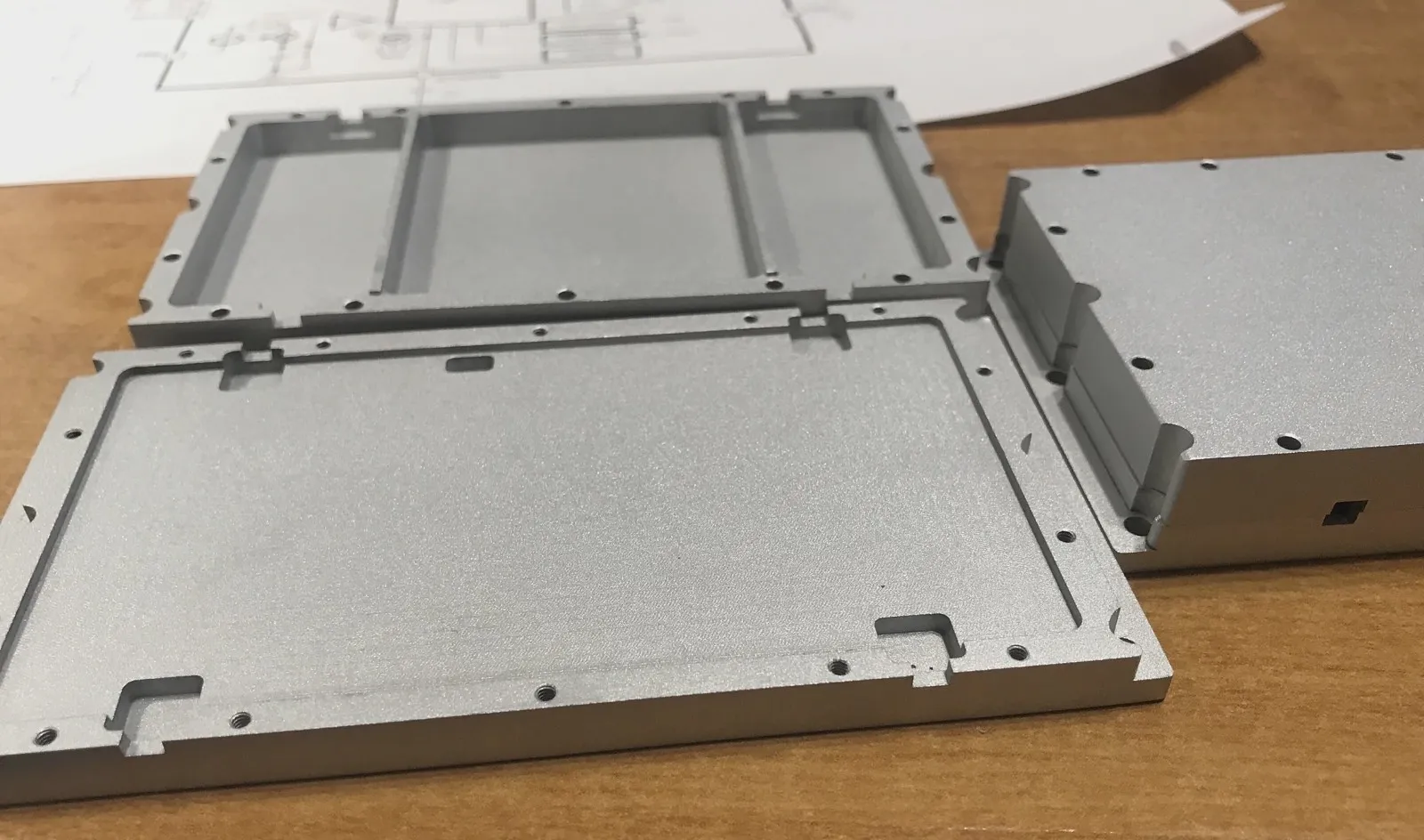
Manufacturing
We build the hardware in Ukraine
Every enclosure milled to our own drawings, every board assembled on our line. No middleman between schematic and finished product — and direct control over quality, lead times, and Danish/Dutch model eligibility.
Let's talk
Open to: venture investment, technology partnerships, contracts under Danish/Dutch model, joint proposals under NATO UNITE, direct procurement.
Write to us- Resident of Brave1 — Ukraine's state defence-tech cluster, founded jointly by the Ministry of Digital Transformation, the Ministry of Defence, the General Staff and three other state bodies.
- UVS Dynamics LLC (ТОВ «ЮВС Дайнемікс», ЄДРПОУ 45674204) — registered Ukrainian legal entity; activity codes (KVED) match the profile — manufacture of aircraft and related equipment, communications equipment and measuring instruments.
- UVS Dynamics is a Ukrainian company; our products are developed and built in Ukraine. Any supply outside Ukraine is subject to Ukraine's export-control regime and requires a permit from the State Export Control Service of Ukraine; Ukraine issued its first such permits to defence-industry enterprises in February 2026. Nothing on this site is an offer to supply outside Ukraine. Foreign partners are welcome to write to us — we will say plainly where any permit stands before anything else is discussed.
Forward-looking statements. This page is for information only. It is not an offer to sell, or a solicitation of an offer to buy, any security or interest, and it is not investment advice. Market figures are drawn from public sources and were not independently verified. Statements about our plans, roadmap, targets and expected product performance are forward-looking: they reflect our intentions as of the date shown, depend on tests, approvals and third parties we do not control, and may change or not materialise. Capabilities described as targets or plans are not delivered capabilities.