X‑band video link for UAVs
Pre-series developmentUVS Link
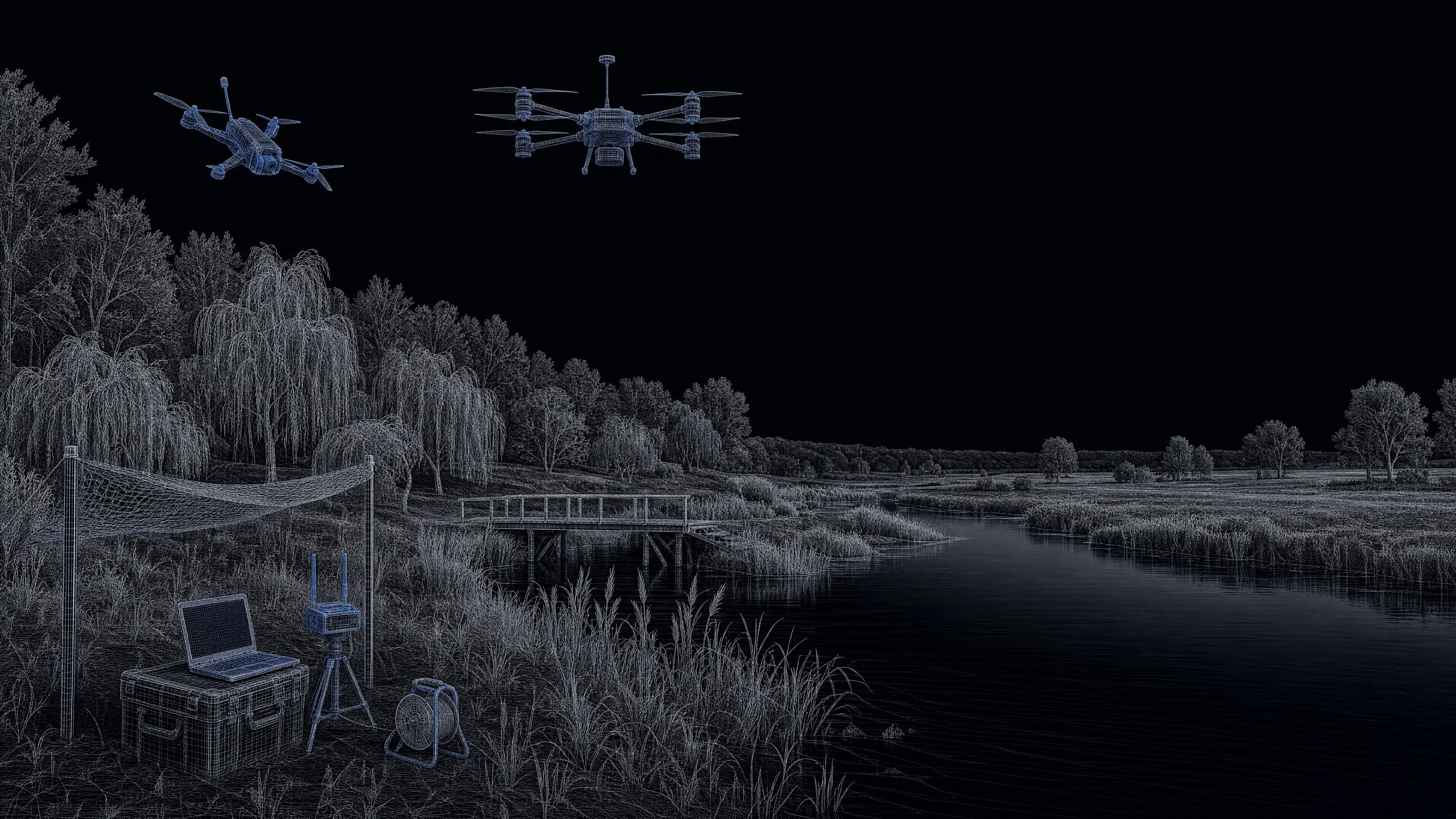
Encrypted video and telemetry from the aircraft to the operator. The air link runs in X‑band, and a second drone flying higher keeps line of sight to the aircraft and relays the signal to the ground station.
- Air → Repeater, 2 W amplifier, ground test
- ≈18.5 km
- X‑band air link, away from 1.2–5.8 GHz
- 8–12 GHz
- Added by the link itself, bench median
- ≈20 ms
- Without a single dropped frame, bench run
- 4 h
01 · System
One link, three nodes
How does the picture reach the operator?
How it works
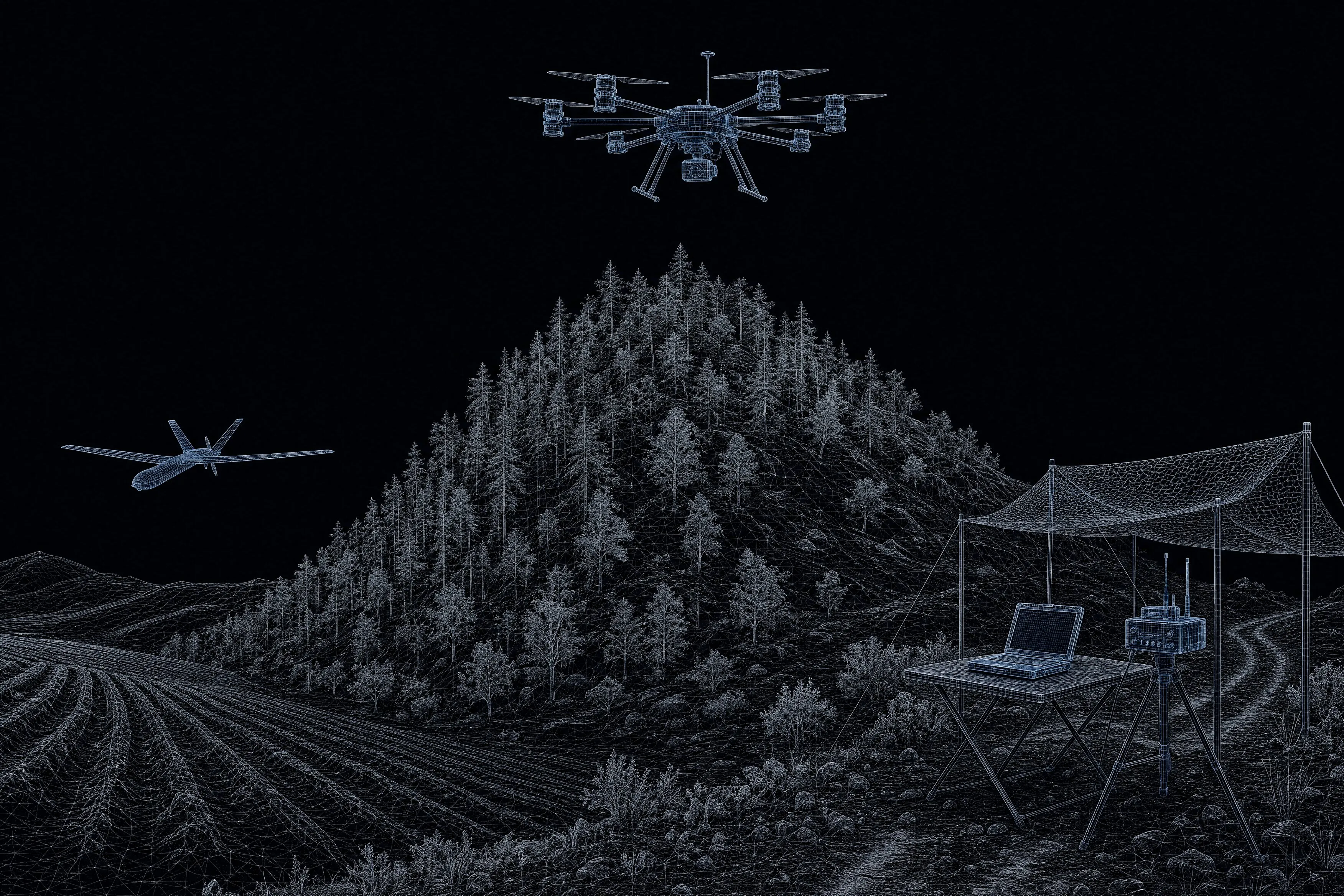
From up high, the link keeps line of sight
The Repeater rises on its own drone, so terrain, tree lines and buildings do not break the link — and the aircraft can fly further.
- X-BAND
- ≈10 KM
- NO LINE OF SIGHT
02 · Range
Two legs, one scale
How far does it reach?
-
Repeater → Ground ≈10 km
-
Air → Repeater · 2 W · ground test ≈18.5 km
-
Air → Repeater · 5 W · as specified up to 40 km
-
Whole link · as specified up to 50 km
- Measured
- As specified
03 · Spectrum
Out of the crowded bands
Why is it harder to jam?
X‑band jammers exist, but they need far more power and cost, so they are deployed point by point rather than as continuous coverage.
Frequency hopping keyed to you
The link hops across X‑band frequencies in a secret order derived from the user’s key. Without the key, the next frequency can’t be predicted.
User key
04 · Security
The Repeater holds no video key
What if a unit is captured?
Air module
Encrypts and authenticates every packet on board.
Repeater
Relays the encrypted stream without decrypting it: even a captured Repeater can’t open the picture.
Ground station
Decrypts the stream and discards forged packets.
Receive-only
A silent ground station
It only receives and never transmits, so it doesn’t give itself away.
Forged packets dropped
Every packet is authenticated; the ground station discards forgeries.
Hardened hardware
Secure Boot, flash encryption and a disabled JTAG make it substantially harder to extract the key or firmware.
Signed updates only
The device accepts only our signed firmware.
05 · Kit
A complete kit, designed in-house
What’s in the box?
Boards, firmware, the frequency converter, the antennas and the software are all ours — designed together, working as one system.
- 01
Camera
Feeds video to the Air module.
- 02
Air module
Video path and X‑band converter on one board.
- 03
Amplifier
2 / 5 WA separate module: 2 W or 5 W, matched to the range you need.
- 04
Antennas
Our own, narrowband, built for the link’s operating frequencies.
- 05
Desktop application
Configures the units, shows video and telemetry.
- 06
Video
720p30H.264, 720p at 30 fps — encrypted on board.
06 · Integration
Works with the software you already use
Will it work with my ground control software?
USB, no drivers
A computer sees the ground station as a standard webcam.
Ethernet streaming
A video stream into QGroundControl or any other system that accepts network video.
Telemetry
MAVLink, MSP, CRSF and DisplayPort OSD — for Betaflight, iNav, PX4 and ArduPilot.
Several aircraft per station
Pin the aircraft you want: if its signal drops, the station switches to another of your aircraft and restores the video as soon as the signal returns.
07 · Specifications
Specifications
- Kit contents
-
- Camera
- Air module
- amplifier
- antennas
- Repeater
- Ground station
- desktop application
- Link
- Air to ground: digital video plus flight-controller telemetry
- Air-link band
- X-band
- Range
-
- Air link, Air → Repeater: about 18.5 km with the 2 W amplifier (ground test), up to 40 km with 5 W
- Repeater → Ground: about another 10 km
- whole link: up to 50 km
- Amplifier
- 2 W or 5 W, as a separate module
- Antennas
- Built in-house, narrowband for the UVS Link operating band
- Video
- H.264, 720p at 30 fps
- Encryption
- Every packet encrypted and authenticated on board; frequency hopping keyed to the user
- Ground station outputs
-
- USB (UVC camera)
- Ethernet video streaming into external systems such as Kropyva or DELTA
- Reliability
- Four hours of continuous operation with no lost frames in a bench run
- Status
- Pre-series development — open to collaboration
Full description
Open to collaboration with military units and UAV manufacturers. We work out the integration into your aircraft together with your engineering team.
Why UVS Link
- An X-band air link. 8–12 GHz — away from the 1.2 / 2.4 / 3.3 / 5.8 GHz bands that most production UAV video links use and that most jamming targets.
- Frequency hopping keyed to you. The link hops across X-band frequencies in a secret sequence derived from the user’s key: without the key, the next frequency can’t be predicted.
- Our own antennas for our band. We build the antennas ourselves, specifically for the UVS Link operating frequencies — as narrowband as the hopping band allows. Fewer stray signals and less interference at the receiver input.
- A ground station that stays silent. It only receives and never transmits, so it doesn’t give itself away with its own emissions — unlike two-way digital links whose ground side transmits too.
- An airborne Repeater. The Repeater flies on its own drone and keeps line of sight to the aircraft — the link does not break behind terrain, tree lines or buildings, so the aircraft can fly further.
- The Repeater holds no video key. It relays the encrypted stream without decrypting it: even a captured Repeater can’t open the picture.
- Every packet encrypted and authenticated on board. The ground station discards forged packets. Secure Boot, flash encryption and a disabled JTAG make it substantially harder to extract the key or firmware from a captured unit, and the device only accepts our signed updates.
- Several aircraft per ground station. The operator pins the aircraft they want; if its signal drops, the station switches to another of your aircraft on its own and restores the video as soon as the signal returns.
- Low latency. The link itself adds about 20 ms (bench median) from a finished frame to the ground station output; four hours straight without a single dropped frame.
- Telemetry for any flight controller. MAVLink, MSP, CRSF and DisplayPort OSD — for Betaflight, iNav, PX4 and ArduPilot.
- No drivers needed. Over USB a computer sees the ground station as a standard webcam, and over Ethernet it streams video into QGroundControl or into systems such as Kropyva or DELTA.
What’s in the kit
UVS Link is designed as a finished product, not a set of modules you have to integrate yourself. The camera, airborne module, amplifier, Repeater, Ground station and desktop application are designed together and work as one system. All of it is our own design: boards, firmware, the frequency converter, the antennas and the software.
- Air module — the airborne transmitter: camera in, encrypted digital video and flight-controller telemetry out. The video path and the X-band converter sit on one board.
- Amplifier — a separate module, 2 W or 5 W, matched to the range you need.
- Antennas — built in-house, narrowband, specifically for the link’s operating frequencies.
- Repeater — a relay on its own drone. Up in the air, it keeps line of sight to the aircraft, so the aircraft can fly further. It receives the X-band air link from the Air module and passes the encrypted stream on to the Ground station without decrypting it — about another 10 km.
- Ground station — hands the video to the operator over USB (a computer sees it as a standard USB camera, no drivers) and streams it over Ethernet into external systems such as Kropyva or DELTA. Flight-controller telemetry goes to the PC.
- Desktop application — configures the units and shows video and telemetry on the operator’s computer.
Range
The link has two legs. The X-band air link from the Air module to the Repeater worked at about 18.5 km in a ground test with the 2 W amplifier, and reaches up to 40 km with the 5 W amplifier. From the Repeater to the Ground station is about another 10 km, so the whole link reaches up to 50 km.
Video and reliability
Video is H.264, 720p at 30 fps, encrypted and authenticated on board: the Repeater relays it without decrypting it. In a bench run the link ran for four hours straight without dropping a single frame at either end.
Why X-band
The main advantage of moving to X-band is that operators sit outside the primary attack vector of EW assets, which are deployed en masse against the L/S/C bands. X-band jammers exist, but require significantly higher power and cost — so they are deployed locally rather than as continuous coverage. In UVS Link, X-band is the air link from the Air module to the Repeater.
08 · Questions
FAQ
Can UVS Link be jammed by EW?
No link is fully immune to EW, but the UVS Link air link, from the aircraft to the Repeater, runs in X-band (8–12 GHz), away from the heavily jammed 1.2 / 2.4 / 3.3 / 5.8 GHz bands. It hops frequencies in a secret sequence derived from the user's key. X-band jammers need significantly more power and cost more, so they are deployed point by point rather than as continuous coverage.
What range does it really achieve, and what does it depend on?
The link has two legs. In a ground test with the 2 W amplifier, the air link from the aircraft to the Repeater worked at about 18.5 km, and with the 5 W amplifier it reaches up to 40 km. The airborne Repeater keeps line of sight to the aircraft, so terrain and tree lines don't break the link. From the Repeater to the Ground station is about another 10 km, so the whole link reaches up to 50 km.
What does the enemy get if they capture the Repeater or the aircraft?
The Repeater holds no video key: it relays the encrypted stream without decrypting it, so even a captured Repeater can't open the picture. Secure Boot and flash encryption are on, JTAG is disabled and the units accept only our signed updates, which makes extracting a key or firmware substantially harder. The user can change the key at any time.
Will the ground station give away the operator's position?
The Ground station only receives and never transmits on air. Unlike two-way digital links, whose ground side transmits too, it doesn't give itself away with its own emissions.
Which flight controllers are supported, and can I control the drone through UVS Link?
MAVLink, MSP, CRSF and DisplayPort OSD telemetry is carried to the ground for Betaflight, iNav, PX4 and ArduPilot. The link is one-way, air to ground: control stays on your own RC link, and CRSF is carried as telemetry only.
How does the video get into our systems — Kropyva, DELTA, QGroundControl?
Over USB, a computer sees the Ground station as a standard webcam, with no drivers. Over Ethernet, the station streams H.264 via RTP into Kropyva, DELTA or QGroundControl, and sends MAVLink telemetry over UDP to port 14550, which QGroundControl connects to automatically.
Can one ground station work with several aircraft?
Yes. The station hears every aircraft in your group, and the operator selects and pins the one they want in the application; aircraft can be given their own labels. If the pinned aircraft's signal drops (10 s by default, adjustable), the station switches to another of your aircraft on its own and restores the video as soon as the signal returns.
Let’s integrate UVS Link into your aircraft
Open to collaboration with military units and UAV manufacturers. We work out the integration together with your engineering team.